The Most Powerful Muscle Is Between Your Ears
Chapter One
"What the f#ck is this?!"
I very rarely heard my dad swear. It was only when he was really drunk, or really angry. He'd just seen my Year 12 results, so I knew it was the latter.
My grades were abysmal. When someone once asked my dad what I was studying at high school, he'd tell them, "Paul majors in football and romance… and is failing both."
It was true. Good grades didn't matter to me — I was going to be a professional Rugby League player in the NRL. But somehow, it hadn't worked out that way.
So how did a deadbeat teenager end up with three biomedical degrees, an award-winning self-designed PhD, and later a decade as Director of Research for one of the most successful sports science companies in the United States?
Good question.
Chapter Two
The wager
After a summer doing all the jobs teenagers do while trying to find their way, I knew two things. First, working for other people wasn't for me. Second, I'd made a tough and very daunting decision.
I went to my parents, with my most humble hat on, convinced them I'd seen the error of my nonchalant academic efforts, and asked if they'd let me live at home one more year to repeat Year 12 — properly this time. I promised them two things: I'd gain entry into a Human Movement Studies Bachelor's degree, which at the time needed a score only the top 10–15% of the state achieved, and in the same year I'd make the Australian Schoolboys Rugby League team, which would virtually guarantee a shot at a professional contract.
Both were lofty goals. But by December the following year, I'd managed both — kind of.
Chapter Three
In by the skin of my teeth
My grades were good — very good — but not quite top 5–15% material. As luck would have it, Southern Cross University in Lismore had just opened its Sports Science department and was looking for students with both a strong academic and sporting background. The Dean used to play Rugby League and was a mad fan of the NRL.
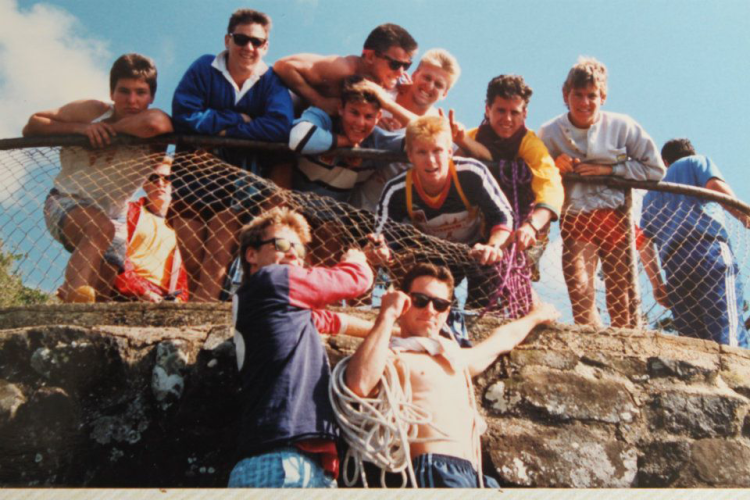
I was selected in the Australian Schoolboys Rugby League squad of 21 for 1988. A squad that contained future NRL stars such as Brad Fittler, Tim Brasher, Jason Croker — I was one of the best teenage players in the country. However, they only took 18 players on tour. I was one of the three left behind. However, thanks to a meeting with legend John Sattler, I gained the interest of Tweed Heads Seagulls, the local NRL club, which made my university application considerably more appealing to a footy-mad Dean. I was in — by the skin of my teeth.
Combining professional football and full-time study turned out to be a lot harder than I'd anticipated. Full-time biomedical study, a six-hour round commute to training four days a week, and interstate games most weekends. After two years I was exhausted, injured, and — if I'm honest — relieved when Seagulls released me. I went and played local football for the mighty Ballina Seagulls, some of the toughest football, best friends and happy years of my life. I graduated with my first biomedical degree, though not with the grades I know I was capable of.
I loved Rugby League, but I was never going to be a star. My body had had enough, too — the barbaric training programs of the era had left me, by 22 years old, living with chronic back pain that would later take away everything I'd worked for.
I was never much good at English or spelling, and mathematics gave me an aneurysm. But I'd found a deep passion for exercise and nutrition science. In high school, while other kids passed notes in class, I was designing individualised weight-training programs for my footy mates — unheard of at the time. As a Sports Science student, I questioned and argued with the coaching staff at my NRL club over gaps in their conditioning and nutrition programs. My appetite for research was ravenous — for a good six or seven years, I read two books a week.
An internship at Pindara Hospital, with its huge state-of-the-art Sports Clinic, led to the position of Exercise Physiologist — thanks to the manager and great friend Rick Martin. The title sounds impressive; however, it consisted of twenty fifteen-minute health assessments a day, six days a week! For the next twelve months — over 4,000 consultations later — this gave me the equivalent of a lifetime's experience in health assessment and exercise prescription.
Chapter Four
"Maaate, this personal training thing is going to be huge…"
At the time I became close friends with a very laid-back guy who cruised into the clinic each week to "pump up" in the gym, then take aerobics classes packed with hundreds of women — I thought that was so cool! He also had an entrepreneurial streak in him like the Tasmanian devil. We hit it off instantly. He'd just returned from the United States and grabbed me in the gym one morning: "This personal training thing is huge over there — let's start it up here."
So we did. By 24, we'd established nine personal training locations and secured exclusive rights across every major hotel chain on the Gold Coast — Sanctuary Cove to Currumbin and out to Mudgeeraba and back. I started out doing twelve sessions a day, six days a week. We ruled the coast, and we had an absolute ball.
We had no structure, no systems — just a couple of lads having fun. Then one of us found the love of his life and got married. It wasn't me.
Totally burnt out, I packed everything I owned into my little Suzuki 4WD and drove to Melbourne, just wanting somewhere different. Within three days I had clients — good ones, including the owners of a major supermarket chain and the owners of Village Roadshow's cinemas and theme parks. I'd start at 6am and be finished by 9am. I remember standing outside Rob and Mem Kirby's Toorak mansion one morning thinking, it's 9am — what am I going to do with the rest of my day?
So I'd drive to Torquay and surf uncrowded Bells Beach, most days.
Then I thought: I've got the time. I should do another degree....
Chapter Five
I enrolled, sat, and cried
I marched into the office of the Head of the Exercise Metabolism Unit at Victoria University and announced I wanted to do a PhD in the nutritional adaptations that optimise muscle gains. He looked at me like I'd offered him a kilo of cocaine.
"Have you studied chemistry? Organic chemistry? Biochemistry?" "Ah — no," I stuttered. "Well, you'd best go do a degree in chemistry. Off you go." Interview over.
Professor Michael "Mick" Carey became my PhD supervisor a couple of years later, and I gave him hell until the day he retired. God bless him.
I walked straight from that forty-seven second interview to admin and enrolled in a Bachelor of Chemistry — three years, paid in full. First day of class, I arrived forty minutes early, sat alone in the empty room, and stared at a huge periodic table poster on the wall. I could not make head or tail of it. The more I looked, the more overwhelmed I got.
What have you gotten yourself into? You can't spell. You can barely count. What were you thinking? ....
As I got up to leave, other students started filing in, and not wanting to look like a total idiot, I sat back down.
I'm not gifted academically, and I never have been. What got me through the fear of being in well over my head was one decision: I would do whatever it takes to see it through. If I needed a tutor, I hired one. If a subject required a textbook, I read ten at the library. If it took me 10 hours of study to learn what my classmates picked up in one, I did it. Whatever it takes became my motto — and it turned out to be a powerful weapon.
I finished with 93% in Biochemistry and 91% in Organic Chemistry. My Organic Chemistry professor told me the only way a student could score above 90% on that exam was by cheating — "but because I know you, Paul, and how hard you work, I know that couldn't have been the case." Probably the nicest thing anyone had ever said to me. I won an academic award of excellence from Victoria University. Me — the kid who majored in football and romance, and failed both. My parents nearly passed out.
Chapter Six
The weight of it all
I finished my second biomedical degree with all High Distinctions, then an Honours year with the same, which qualified me for a fully funded PhD scholarship. I turned it down — my PT business was going well, and I didn't want to take that funding from a kid who needed it more. I convinced Mick to let me design my own PhD instead, in an area his lab had never touched.
The problem was that by 29, my back was genuinely bad. Standing for more than fifteen minutes was unbearable. I sat the three-hour biochemistry exam I scored 93% on lying across a Swiss ball, because I couldn't sit in a chair. Years of poorly designed programming and lifting with bad form had left me, by my late twenties, with the spine of an eighty-year-old.
Some days the pain was so bad that ordinary things — getting to the bathroom, making a meal — became impossible. I lost my PT business, and I dropped out of university.
It's a large part of why I'm so passionate today about teaching correct technique in the gym. I know now, first-hand, the cumulative damage that catches up with you years later.
Chapter Seven
Fifteen months on the floor
I spent the next fifteen months mostly on the floor of a one-bedroom apartment going from spine specialist to specialist. I'd deliberately rented in Carlton, right across from Melbourne University, cause it had the best biomedical library in the country. I'd shuffle over, lay on the library floor reviewing journal articles until one or two in the morning, then shuffle home.
Specialist after specialist told me the same thing: there was nothing they could do. One smiled and said, "Hey you've got abs!!" — which didn't help much. I couldn't work or support myself. I still tried to go surfing with my mates most Sunday mornings, they let me lay across the whole back seat for the round trip, I was just happy to be in the water with them. After fifteen months of "no's", and some of the darkest thoughts I've ever had, I found a surgeon — by sheer chance — who was willing to operate.
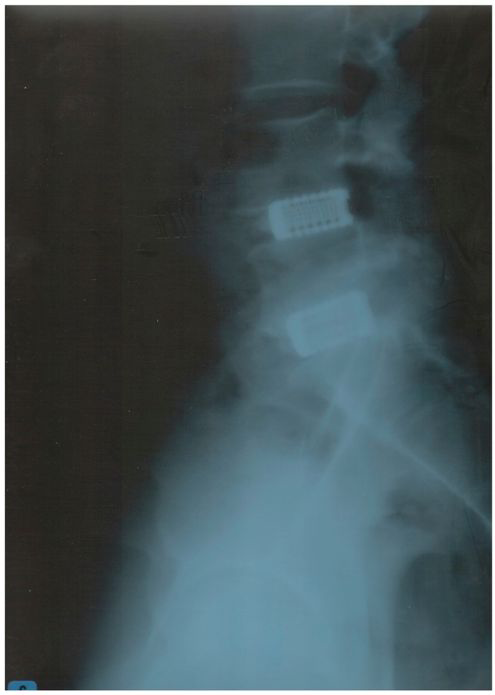
A discogram revealed not one but two completely ruptured discs. My surgeon told me they came out "like mush." This was 1999, and the only option then was a two-level spinal fusion — the first he'd ever performed — four titanium bolts across both disc spaces, seven hours in surgery, and a spinal cord lifted out and over to reach the damage. The first three months of rehab were about learning to walk again; the next three, about learning to live with a spine fused to my pelvis.
After the operation, my surgeon handed me a form. "Fill this out — you probably won't work again, so this will help." It was an application for a disability pension. I couldn't bring myself to do it. I'm still glad I didn't.
Six months post-op, I walked back into Mick's office. "Mick, I'm back." "Okay," he said, not even looking up from whatever he was doing. "What do we do now? You don't have a scholarship."
Chapter Eight
The phone call that changed everything
To keep myself sane during those fifteen incapacitated months, I'd written something — a fully detailed research proposal for my PhD: the thesis, the rationale, the design, the clinical trials, fully referenced and fact-checked. I paid a professional editor to help with structure and grammar, and paid my biochemistry-grad mates in beer to review the hypotheses.
Then I sent it, by post, to the most progressive sports science company in the United States at the time — AST Sports Science, just outside Denver, Colorado — on a whim, never really expecting anyone to open the envelope.
In June 1999, lying in my car outside a physio appointment in Melbourne, my phone rang. It was Paul Delia, AST's founder and CEO. He'd read the proposal, loved it, and was ready to get started. The trouble was, I'd never heard an accent as strong as his — a proper Mississippi drawl — and I assumed one of my surfing mates was taking the piss. I told him to f#ck off and hung up.
Thankfully, he called back. He hired me on the spot as Director of Research for the entire company. Paul and I became great mates over the next decade — board meetings in jeans and t-shirts at local microbreweries, training camps with some of the world's best athletes, textbooks and research reviews published with leading sports scientists and medical professionals. Alongside my great friend Professor Alan Hayes, who became Head of Faculty at the EMU lab, we completed award-winning research that's probably even more important today then it was back then.
PUBLISHED RESEARCH
Chapter Nine
Bringing it all together
My PhD was in the exercise and nutritional concepts that optimise muscle gain and body composition — a long-winded way of saying "body transformation." I knew the research would help a lot of people, but I never forgot that at heart, I was a personal trainer. I just happened to also work alongside some of the best minds in sports and biomedical science.
I knew that if I could bring it all together, it could help a great many more. So I created Metabolic Precision — the complete science of body transformation. From around 2010, I certified and coached more tham 1,000 fitness professionals: osteopaths, physiotherapists, yoga instructors, gym owners, and personal trainers of every age and stage, from all over the world.
CHAPTER TEN
A community, not just a certification
So many of the coaches I certified became my dear friends, and family. I never had a big family of my own — maybe that's what I was really building.
What I always enjoyed most was the community that grew out of it: a safe environment where we could all learn from and support one another, which so many of our coaches, even today, still tell me was the most valuable part of the whole program.
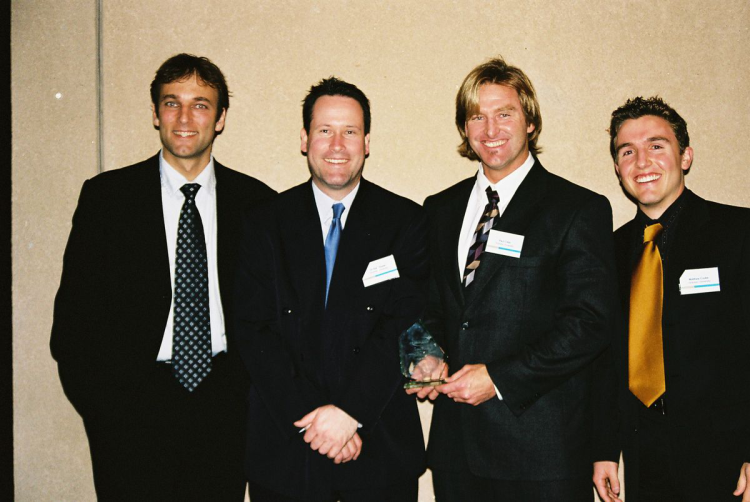
The clearest expression of that culture was our annual awards night — 400 guests the first year, then 500, then 600. By 2019, we were celebrating with more than 700 members of the MP community: coaches, staff, and their clients. It really was something special.
Chapter Eleven
When everything fell apart
Then Covid hit. Like the rest of the world, I didn't know what to do in an environment that was changing daily. The lockdowns saved lives — but by the eighth lockdown in Victoria, of the thousands of coaches in my network, fewer than ten were still practising our program. Through those years I sat in front of a computer ten or more hours a day, most days, trying to help my team weather the storm, watching businesses I cared about reduced to shells of what they'd been. The chronic, unrelenting stress took a toll on everyone — including me.
During that fallout, I lost my dog. My marriage. Both of my parents. My home, my income, my business, my client base — all of it. I was broken, in every way. I walked away from the fitness industry and lived a completely different life for a while. I needed time away, to heal and reset.
Chapter Twelve
Starting again — for the right reasons
I'll be honest with you: I knew what was being taught about the female body wasn't enough. For years, we fell short for our female clients — not because we didn't try or care, but because everything we were taught was built around a body model that was never female. Nobody questioned it. We accepted it, and too often, the women in our lives and our community paid the price.
That realisation never left me. So now, with the chance to start again, I've rebuilt Metabolic Precision from the ground up.
MP Women is not a revision. Not an update. It is a complete rethink of how we understand, assess, and support women — grounded in cutting-edge science, and designed to deliver genuine individualisation unlike any other accreditation available today.